
Saturday Summary - Week 17 - Two Weeks in One Place (On Purpose)
- Karen Kuhl
- Mar 2
- 4 min read


Two weeks. In one place. If you know me, you know that’s been a stretch.
We stayed to volunteer with Habitat for Humanity through their RV Care-A-Vanners program. And I’m really glad we did.
Travel With Purpose


The Care-A-Vanners program allows RVers like us to travel to build sites across the country. In exchange for volunteering, we receive an RV site with electric, WiFi, laundry, trash, and a dump station, a very welcome budget break.
A bit on how Habitat for Humanity works. Their housing projects aren’t a handout, they’re a hand up. Families apply and are selected based on:
Their level of need
Their willingness to partner
Their ability to repay an affordable mortgage
Homeowners complete financial education and invest hundreds of hours of “sweat equity,” working alongside volunteers. Nationwide, Habitat’s mortgage default rate is less than 1%. It’s a partnership model, and it works. Why isn't this the norm? Every person considering ownership should be required to receive that financial education, rather than becoming prey to financial institutions that benefit from foreclosure.
The volunteers working on these homes are primarily retired professionals who won't "let the old man in." I had this realization after departing from the build. Don mentioned an interview with Clint Eastwood in which he said that not letting the old man/woman in is a secret to aging well. They are intentional in the manner they approach their days, regardless of age. They are living with vitality and not succumbing to the weariness or cynicism that can accompany aging. I may have been the youngest in the build, but they were the professionals rocking the job.
Week One: Drywall and Doubt


I showed up thinking: What the heck do I know about building a house?
My first week was drywall. When we arrived, only a few of the walls had drywall. The delicate cuts around outlets and fixtures, I let more experienced hands take those on; I didn’t want to be the one to cut through any wires. I know how bad that is for the electricians, so I've heard over family dinners at Grandma's house! By the end of the week, I was confidently performing the “double click” test, making sure every screw was set properly before the professional drywallers arrived to mud.

The workday rhythm was steady:
8:00 instructions
10:00 break
12:00 lunch
2:00 done
It wasn’t the physical work that challenged me as much as the New Mexico heat and the responsibility. I didn’t want someone correcting my mistakes after I left. I wanted to truly contribute. The most meaningful shift happened when I worked alongside the future homeowners. Suddenly, it wasn’t drywall. It was their house. It reinforced the importance and value we were providing.
Week Two: Trusses and Framing


The second week, we moved into trusses and framing. Trusses work is very wind-dependent, too much wind and the whole operation stops. Desert spring is basically “wind season,” so this part of the job had to be timed with the winds.
The process was divided into four teams:
A ground team (that was me) hand-lifted each truss to the second team.
A second team standing on scaffolding pulled the truss into the roofline.
A third team on the interior framing used long “pushers” to slide and angle the truss into position.
The roof team, standing on temporary boards, waited for the angle to rise high enough to grab and secure it.

It sounds chaotic, but it wasn’t. It was efficient, coordinated, and honestly kind of incredible to watch. Every truss went up between 9:00 and 2:00, including a lunch break; the process was extremely efficient. By the end of that day, the house had a roofline. It finally looked like a home. In the following days, I moved into framing. We installed the top plates to lock the walls together and added nailing boards for the future drywall. Because I had worked on drywall the week before, I understood why those boards mattered. We used table and hand saws, tools I was already comfortable with from projects back home, and the instructions were clear. Many boards had to be notched to fit just right. It wasn’t easy work, but it was challenging in the best way. Other teams worked on roof sheathing. That is not work I would volunteer for. By the end of the week, the house was fully framed and half sheathed.
The People

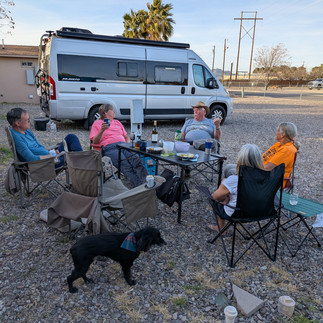


The work matters, and the RV Campers team made it special. We shared dinners, played board games in the conference room, gathered around the firepit, and had happy hours. There’s something powerful about a temporary community.
Beyond the Build


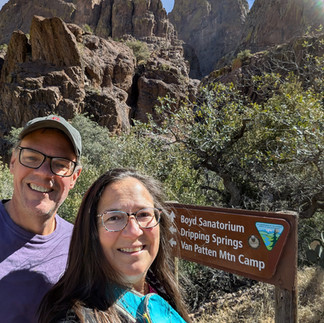


On Sunday, the one day we both had off, we explored Las Cruces. We biked to see the Giant Chile Pepper with Lucky riding in her basket. We hiked Dripping Springs in the shadow of the Organ Mountains. I overbought groceries at Toucan Market (shopping while hungry, at a family-owned grocery store, does this to me), yet somehow fit it all in the bus. We even included a local stage performance of Night Watch; it really was great! We dealt with differential fluid issues (because apparently tires leak more than air) and learned that the desert wind season can cause whiteout conditions just like snow back home. Life keeps happening alongside purpose.
What I’m Taking With Me

I left this project inspired. Volunteering is somehow the humblest and easiest thing we can do, and it has such a huge impact. I learned new skills. I stretched my comfort zone. I trusted instructions. I measured more carefully than I ever have in my life. Most importantly, I met amazingly kind people I will think about for a very long time. Two weeks in one place felt uncomfortable at times. But staying present and finding value might be one of the most important parts of this Adult Gap Year.
But we were really ready to move on.


Comments