
Saturday Summary - Week 33 - Trolls, Mice, Rain Shadows & the Crown Jewel of Bike Trails

June 14 – June 20 | North Bend, WA (80s) → Spokane Valley, WA (80s) → Haugan, MT (80s)

Where We Stayed
Tinkham Campground — North Bend, WA (Sunday–Tuesday)
Roam America RV Park — Spokane Valley, WA (Wednesday & Thursday)
50,000 Silver Dollar — Haugan, MT (Friday)
We left Rockport and the North Cascades on a high note; that kayak on Diablo Lake set a really high bar. It is officially kayak season, and I am here for it. No more alligators, no more dry riverbeds. Lakes, rivers, majestic vistas. Also, finally, good weather for bike trails.
Troll Named Jakob
En route to North Bend, we hit Seattle traffic on a Sunday. A Sunday! I genuinely thought we'd avoid it. I can't imagine what a Wednesday would look like.
The silver lining was a stop we'd been looking forward to: Jakob Two Trees, one of Thomas Dambo's trolls in Issaquah, WA. Back in Week 4, on Thanksgiving Day, we visited a traveling exhibit of Dambo's work at the Asheville Arboretum. I knew his permanent, much larger trolls were scattered across the Pacific Northwest and made a mental note to find at least one. Jakob stands about 14 feet tall along the Rainier Trail, fashioned entirely from recycled and fallen organic materials, looking down at passersby with a ponytail held by a band made by the Snoqualmie Tribe and a necklace of birdhouses draped over his fur. He invites the forest creatures to come spend an afternoon with him. I wished I could just camp there, but that isn’t an option.

His poem is carved nearby:
"A hundred circle suns not old
Cause time will stretch
And loop and fold
So stop, breathe in —
Breathe out, behold
The trees has sung
The story is told"
I'm not big into poetry, but this one resonated with me. It was a perfect mile walk after being cooped up in traffic, and one of those silly, joyful stops that make this trip what it is. We also bought lemonade from high schoolers raising money for a trip to New York City. The road sometimes folds back on itself in funny ways.
Tinkham Campground
Tinkham Campground is a Federal Forest Service campground (I think our first of the trip) and the most shaded, most "lost in the woods" site we've had. We had to switch sites to find better solar exposure, but even then, it was weak. The camp host was wonderful, understanding, and solar-dependent herself, so she got it immediately. We loved being tucked so deep into the trees. Don declared it the campground most likely to have bears of anywhere we've stayed. It was set right next to a river, surrounded by tall trees, and with salmonberries growing everywhere (apparently a bear favorite). No bears appeared, but the possibility felt very present.
Don, being Don, found a way to work with his feet literally in the river one evening. "So long as I have a good signal, I can work anywhere" has become something of a mantra for him. The river apparently had a good enough signal. I also met a young camper, about nine years old, who was traveling with his mom for an extended stretch. He came by the bus a couple of times, completely fascinated, and turned out to know more about engines than most adults I've met. We talked about the Rivian with a frunk parked nearby. A good kid.
The Mouse
We heard something. Then Don saw something. Then we heard it all night.
We have a mouse.
When I told my mother (whose nickname is Mausi, which is German for "little mouse") she replied without missing a beat: "Too bad it's not me." And honestly, I totally agree. A visit from my mother, I would welcome. This particular houseguest was a little less invited.
This led to a 4 am departure from Tinkham, which kind of stinks, to try to sort out the situation. We stopped at a 24-hour IHOP for coffee and a strategy session, because that is the kind of trip this is. The plan: find a hardware store, get traps, and book a cabin or short-term rental so we could actually sleep.
I found an Ace Hardware in Spokane. Ace has become our go-to hardware store on this trip, always locally operated, and always staffed by people who actually know what they're talking about. I'd planned on non-kill traps, but they were out of stock, so the kill-instantly version became plan B.
Next door was Huckleberry's Natural Market, a locally owned grocery store with a beautiful selection of local goods, where I stocked up on some yummy local ingredients.
The Cascade Rain Shadow
Let's talk about this phenomenon. Driving from Tinkham toward Spokane, we didn’t really expect what happened next: the trees disappeared. Not gradually, but suddenly. One moment we were in dense Pacific Northwest forest, and the next we were looking at open grassland and sagebrush. What the heck?!
We were crossing the Cascade rain shadow, something I'd heard about but never experienced firsthand. Pacific storms roll in off the ocean, hit the western slopes of the Cascades, and drop nearly all their moisture there, which is why the Hoh and Quinault rainforests are so lush and dripping. But once that air crosses the peaks and starts descending on the eastern side, it's already spent. The forests that thrive on the wet western slopes simply can't survive over here. What replaces them is dry grassland, scattered pine, and sagebrush stretching toward Spokane and the Columbia Basin.
It's one of the most dramatic ecological shifts in the country, and it happens over a shockingly short distance. Seeing it happen through the windshield is something else entirely; this is also one of the things I end up researching to write this blog. I love learning about our trip and sharing what we learn.
Roam America RV Park, Spokane Valley
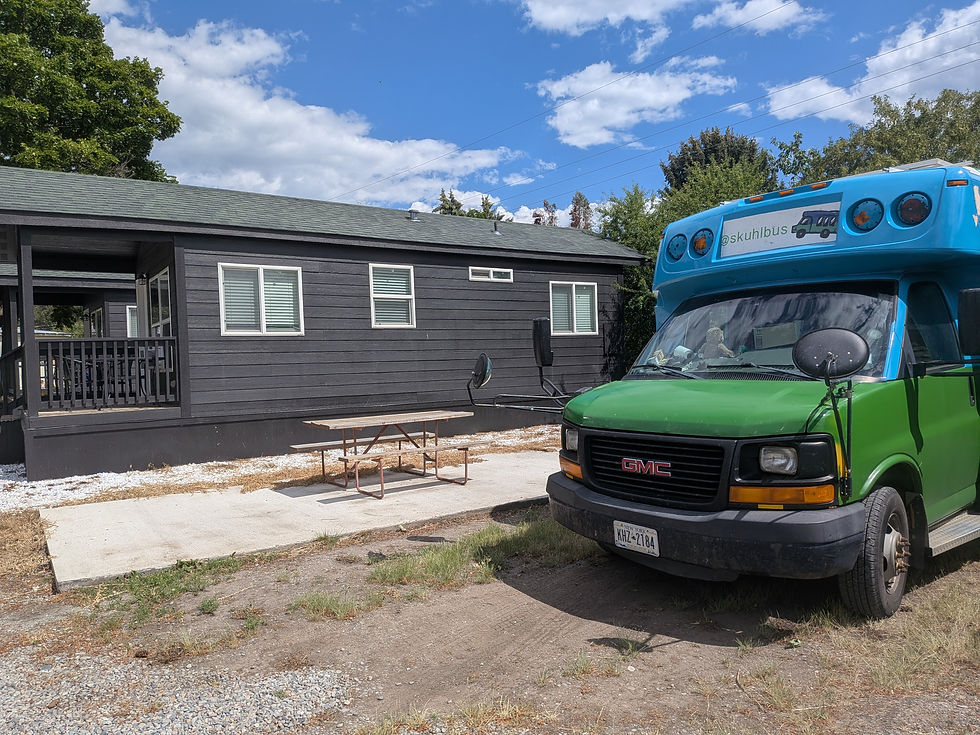
The cabin at Roam America was exactly what we needed; not fancy (we used all our own pots, pans, and dishes) but clean, cool, and mouse-free. I baited the traps with peanut butter, then refreshed them with dog food when the heat started melting the peanut butter (Don's idea, and the dog food held up better). Then I emptied a significant portion of the bus: all our food, Lucky's food, dishes, pillows, clothes, anything in soft packaging that a mouse could work through.
Our deal: I set the traps, Don cleans them.
The mouse, or mice, did not touch a single trap. Our working theory was that 90-degree city heat convinced our country mouse to pack up and leave. I spent a fair amount of time imagining their adventures in Spokane. Someday I might write that blog, haha
Don spent one night back on the bus to confirm they were really gone. He slept well. No mice. We kept the traps baited just to be sure and quietly hoped for the best.
We also used our Spokane days to tackle another lingering issue: our BLUETTI battery's car charging cable had stopped working. Don ordered a replacement through an Amazon locker, this is our first time using one of these. For people living on the road, those lockers are genuinely brilliant. Delivery to wherever you happen to be parked that week.
Fire Season

As we drove through northeastern Washington, our phones started going off. Fire alerts, at three distinct times, all for localized fires in the area. They even showed up as warnings on Google Maps while we were planning our route. My stomach dropped.
Here's the thing about living in the Northeast: when we hear about fires out west, we hear about the big ones. The deadly ones. The ones that make national news and wipe out whole communities. That's the frame of reference I had, and those three alerts hit me with that full weight all at once.
We took a breath and looked around. No roads were closed. No one near us seemed alarmed. We never saw smoke. We never saw fire. The locals were going about their day completely normally, and that told us more than the alerts did. We learned quickly to take our cues from the people who actually live here. Fire season in the Pacific Northwest is a reality they navigate every year — and there's a big difference between a localized fire that crews are managing and the catastrophic events that make the evening news a thousand miles away. We didn't know that difference before this drive. We do now.
It was a good reminder that living on the road means moving through other people's normal, and sometimes their normal looks alarming until you understand it.
Crossing State Lines on a Bike
To pick up the package, I biked along the Centennial Trail. It was a two-hour round trip on my Lectric Bike, which was a fantastic way to spend my morning. Most of the trail is on a well-maintained paved trail along the Spokane River. The only downside was a stretch running parallel to I-90, which isn't exactly the scenic ideal.
The real fun was crossing state lines on the bike before Don or Skuhlie did. The trail markers, both on the path and painted on the pavement, counted down to the Idaho/Washington border. The 00 marker at the state line was one of those small, memorable moments. The North Idaho Centennial Trail runs 23 miles from the state line east to Coeur d'Alene Lake, connecting with the Spokane River Centennial Trail on the Washington side. Both are Class I and II paved trails open to walkers, joggers, and cyclists. If you're in the area, you should go. The Amazon locker was super easy to use; the only problem was that we bought the wrong cable.
50,000 Silver Dollar — and an Attempt at a DDD Meal

On the way to our overnight in Montana, I stopped to do laundry and spotted a diner featured on Diners, Drive-Ins & Dives. I'd always thought it would be fun to eat at one of Guy's picks, and here was our chance. We arrived at closing time. Very sad.
The Coral Café down the street, however, turned out to be a genuine find. It was only in its second week open, run by an owner who came out to chat about the menu and what he was trying to build. The croissant chicken sandwich was fantastic. I'm wishing him all the luck, both because he was a genuinely great guy and because the food earned it.

At the exit for our overnight, a milkshake stand had been advertising itself for miles: "The Best Huckleberry Milkshake." We had to stop. First of all, I didn't know what a huckleberry tasted like, and then there's the line from Don's favorite movie (Tombstone) "I ain't your Huckleberry," which sealed the deal. We stopped. We tried it. I don't think it was the huckleberry's fault, but that milkshake was decidedly not the best.
The 50,000 Silver Dollar travel center in Haugan had free RV sites nicer than we expected, a restaurant, a gas station, a store, a bar, and, yes, a casino. It worked perfectly for a one-night stop.
(The mousetraps remained unsprung, but we heard the mouse again. The saga continues.)
The Hiawatha Trail — The One I've Been Waiting For
In the summer of 2025, before we started this trip, I came across a post about the Hiawatha Trail. I bookmarked it immediately and built it into our route. I've been looking forward to it for almost a year. I can't believe we're actually here and we actually did it.
The Route of the Hiawatha is a 15-mile rail-to-trail ride through the Bitterroot Mountains on the Idaho/Montana border, converted from the old Milwaukee Railroad route. It's been named to the Rail-Trail Hall of Fame; one of only about 30 trails in the country with that designation. The trail starts with a trip through the St. Paul Pass Tunnel, this tunnel is 1.66 miles long, burrowing under the Bitterroot Mountains in total darkness. In total there are nine tunnels and seven sky-high trestles, and the whole thing runs on a gentle 1.6% downhill grade, so the riding is manageable for almost anyone. Shuttle buses bring you and your bike back to the top at the end.
The only downside for us is that there are no dogs allowed. Not in baskets, not in trailers. Simply no. We prepared carefully. Left four windows open, fan running, curtains up, and plenty of water. In a 70F day, Lucky was perfectly fine and happy in her home when we returned. But I missed her on that trail.
The weather was perfect. Mid-70s, clear, with the kind of mountain air that makes you want to breathe deeply and slowly. We took longer than expected because every viewpoint and every photo moment was worth stopping for, and we stopped often.
The St. Paul Pass Tunnel, that first mile and two-thirds of pure darkness, felt like a very long mile. We had headlamps, but honestly, they barely made a dent. The bike lamps were what actually worked. Riding blind through the mountain with nothing but a small beam of light in front of you, the cold air of the tunnel rushing past, is one of the stranger and more memorable experiences of the trip so far.
The Kelly Creek Trestle, the tallest and longest on the trail, is 850 feet long and 230 feet above the canyon floor. I kept my eyes straight ahead and kept pedaling. The trail was solid and well-maintained, but a 230 foot drop is 230 feet!
The trail was everything I hoped it would be. I would love to find more trails like it, though I suspect nothing will quite match this one.
Next up: Slowly making our way to Grand Teton National Park.


Comments